
Boral Roof Repair in Philadelphia: A Homeowner’s Guide
Boral roof repair in Philadelphia typically costs $400-$1,200 for standard tile replacement and underlayment patching, with full ridge-cap rebuilds running $800-$2,500 depending on access and mortar matching. Most Boral tile issues we see in Philadelphia aren’t actually tile failures - they’re fastener corrosion, cracked mortar caps from freeze-thaw cycles, or underlayment breakdown that a shingle-trained crew missed. If you’d rather not climb up there yourself, call us at (855) 554-5116 and we’ll walk you through what you’re seeing.
Here’s the thing most homeowners don’t hear: Boral concrete and terracotta tiles are engineered to last 50 years, yet most Philadelphia homeowners who call us about a “Boral problem” actually have a fastener or underlayment problem that a shingle-trained crew created. We’ve been up on roofs in Roxborough, Mount Airy, and Chestnut Hill where someone slapped sealant on a hairline crack and called it fixed - only for water to find its way under the tile, through the compromised underlayment, and into the kitchen ceiling six months later. That mismatch between material and method is what this guide is about.
Why Boral Tiles Need “Lift-and-Replace,” Not Sealant
The default repair for too many Philadelphia roofers is a tube of polyurethane sealant across whatever crack they spot. That works on asphalt shingles because shingles are the waterproof layer. Boral tiles are not. They’re the first line of defense, designed to shed most water while the underlayment beneath handles what gets through.
When you seal a cracked Boral tile in place, you create a dam. Water still enters at the crack, but now it pools instead of running off. It migrates sideways along the tile’s underside, follows the natural channel between tiles, and finds the nearest gap in the underlayment. By the time you see a stain, the damage is rarely at the sealant spot - it’s often three or four feet downslope.
The correct method is lift-and-replace: carefully remove the damaged tile without breaking its neighbors, inspect the batten and underlayment beneath, replace any degraded components, and seat a new tile with proper fastening. In Philadelphia’s climate, we also check that the replacement tile’s profile matches exactly - Boral has shifted molds over the decades, and a mismatched tile breaks the water channel that the whole system depends on.
We pulled one job in Germantown where the previous company had used three different sealant products on the same slope, each a different color, each trapping water in its own pattern. The homeowner had three separate leak locations, none of them near the original crack. Lift-and-replace from the start would have cost half what the eventual fix ran.
How Philadelphia’s Freeze-Thaw Cycles Attack Ridge Caps Differently
Boral field tiles handle Philadelphia winters well - concrete and terracotta don’t absorb enough moisture to spall in normal conditions. But ridge caps are a different story. They’re mortar-set, not mechanically fastened, and that mortar is the weak point.
Here’s what happens: water gets into hairline cracks in the mortar during a January rain-snow mix. Temperature drops to 18 degrees that night in Northeast Philadelphia, the water freezes and expands, and the crack widens. Next thaw, more water enters. By March, the cap is loose or missing, and wind-driven rain has direct access to the ridge beam.
Signs you can spot from the ground:
- Missing or shifted caps along the ridge line - look for dark gaps where mortar should be
- Granular debris in gutters or at downspout outlets that matches your mortar color, not shingle granules
- Uniform staining on the fascia directly below the ridge, suggesting water is entering at the peak and running down
- Caps that sit higher or lower than their neighbors, indicating the mortar bed has cracked and settled
Ridge-cap repair isn’t just re-bedding the same cap. In Philadelphia, we remove the failed caps, inspect the ridge board for rot (common when leaks have run for multiple seasons), install new mortar with polymer additives for flexibility, and reset caps with proper overlap. A proper ridge job on a Boral system should last 20-plus years. We’ve seen quick re-beds fail in two.
The Underlayment Inspection Every Boral Repair Needs
This is the point competitors skip because it’s invisible and hard to sell. Boral tile systems are designed to let water past the first layer. The tile sheds 90% of rainfall; the underlayment handles the rest. When that secondary barrier fails, you have no protection at all - and because tile roofs don’t show damage the way shingle roofs do, the failure can progress for years.
Any legitimate Boral repair in Philadelphia should include underlayment inspection at the repair zone. That means lifting tiles in a pattern around the damage, photographing the underlayment condition, and checking:
- Batten integrity - wood battens rot at fasteners first, creating sag points where water collects
- Fastener corrosion - galvanized nails in Philadelphia’s humid summers and salted winter air don’t last forever
- Underlayment embrittlement - asphalt-based felt becomes brittle after 15-20 years; synthetic underlayments can delaminate
- Flashing integration at valleys, walls, and penetrations - the most common leak source we find on Boral systems in Center City rowhomes
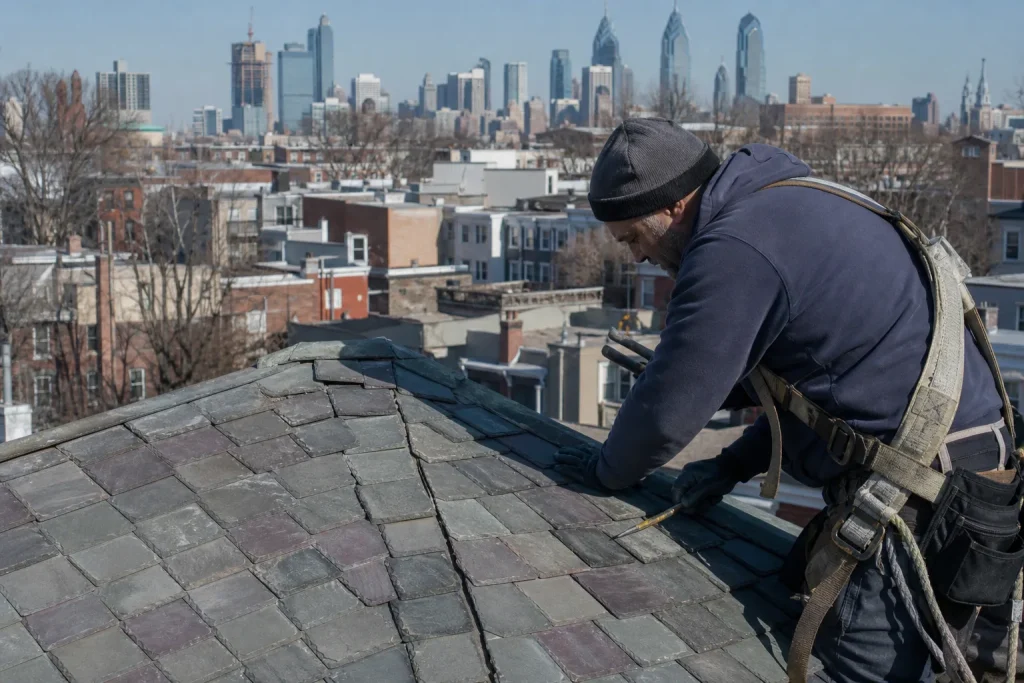
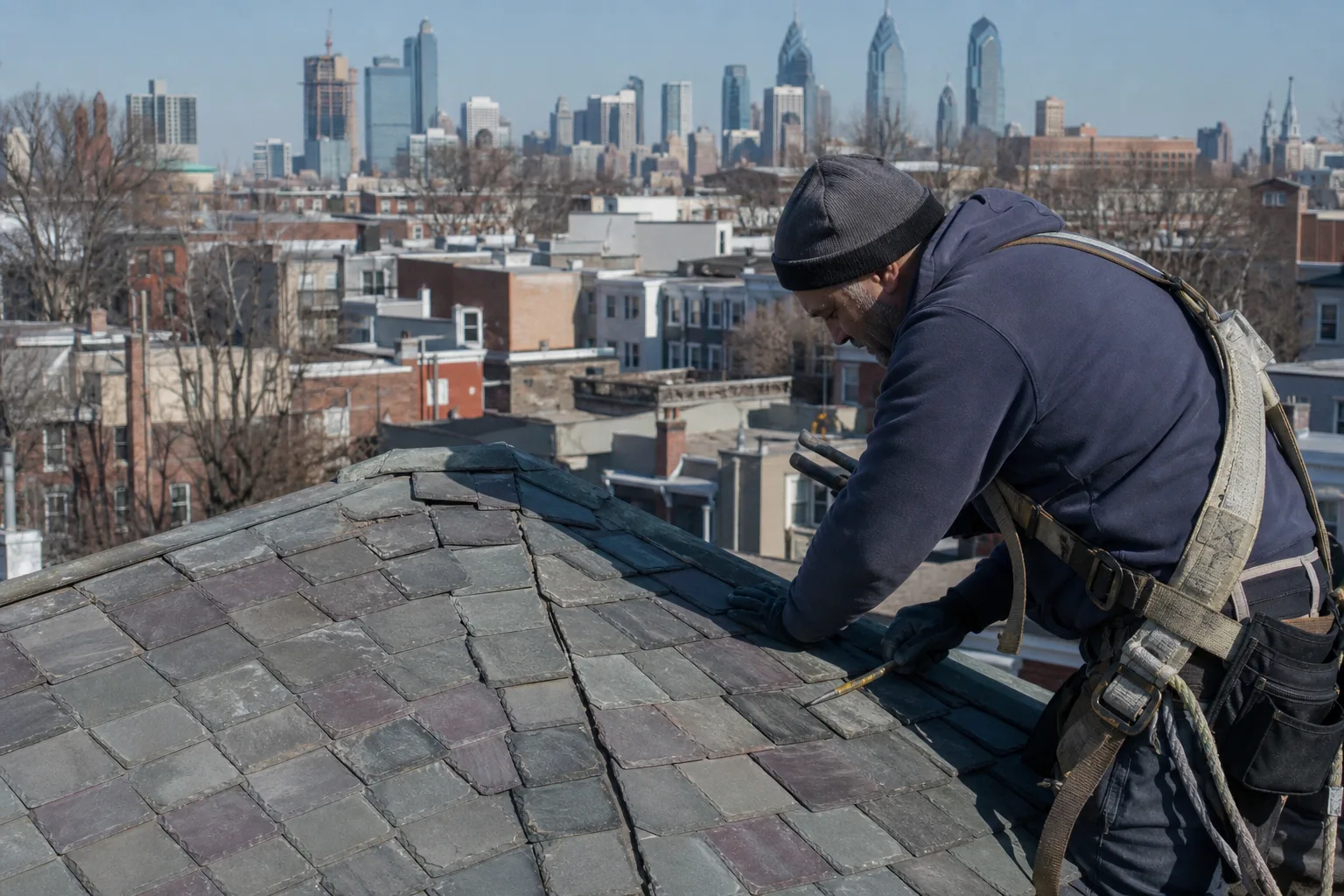
We document every inspection with photos taken from your actual roof, not a generic report. Our Ridgeline Roofing Co. of Philadelphia home page shows what that documentation looks like. If a contractor won’t show you photos of your specific underlayment condition, they didn’t look.
How to Vet a Contractor’s Actual Boral Experience
Philadelphia has plenty of competent roofers. Fewer have meaningful hours on Boral tile specifically. Here’s how to tell before they set a ladder on your property:
Ask: “What Boral profile is on my roof, and do you stock replacements?” Disqualifying answers: “They all fit about the same” or “We can order something close.” Boral’s Saxony, Gemstone, and Villa profiles have different overlaps, nailing patterns, and water channels. Close doesn’t work.
Ask: “Do you use mortar or foam for ridge and hip repairs?” Foam is faster and cheaper. Mortar is correct for Boral systems in freeze-thaw climates. A contractor who defaults to foam is cutting a corner that’ll cost you later.
Ask: “Will you inspect the underlayment, and can I see photos?” Any hesitation here suggests they’re planning to swap visible tiles and move on. The underlayment is where the real protection lives.
Ask: “What’s your workmanship guarantee?” Our Roof Repair in Echelon page details our 90-Day Done Right Promise - written, no paperwork runaround, no arguing. If it’s not right, we make it right. A contractor without a written guarantee is asking you to trust their good intentions, and good intentions don’t stop leaks.
We’ve been serving Philadelphia since 1984, and we’ve trained apprentices into journeymen who know tile systems from the substrate up. That’s the standard we hold for work done in our own mother’s home.
What a Photo-Documented Boral Inspection Should Show
When we finish a Boral inspection in Philadelphia, our report includes specific images that tell the system’s whole story. Homeowners should expect to see:
- Flashing condition: Step flashing at walls, valley flashing, and penetration collars - all the places where tile systems transition to other materials
- Batten condition: Straight, sound wood with corrosion-free fasteners; no sagging or end-rot where water collects
- Tile-to-tile alignment: Consistent overlap, no lifted or settled tiles breaking the water channel, no evidence of foot traffic damage from previous repairs
- Mortar bed integrity at ridges and hips: Consistent thickness, no voids, proper adhesion to both cap and field tile
These photos aren’t for our portfolio. They’re for your records, and for the next contractor who works on your roof - so they know what they’re inheriting. We keep them on file, and we share them with you directly.
When to call a pro: If you’ve spotted missing mortar, cracked tiles, or interior staining that seems to worsen after wind-driven rain, the system is already compromised. Boral tile doesn’t fail gradually in ways you can monitor. It fails in ways that let water accumulate until the damage is structural.
Related services in Philadelphia: For full system replacement or new installation, see our Roof Replacement & Installation in Echelon page. For clay, concrete, or slate systems beyond standard asphalt, our Specialty Roofing in Echelon team handles material-specific approaches.
The Bottom Line
Boral tile roofs in Philadelphia fail when they’re treated like something they’re not. The material is sound; the methods applied to it often aren’t. Lift-and-replace repairs, mortar-set ridge caps, underlayment inspection, and profile-matched replacements - these aren’t upgrades. They’re the baseline for a repair that holds.
Key takeaways:
- Sealant on cracked Boral tiles creates water dams; lift-and-replace is the correct repair method
- Philadelphia’s freeze-thaw cycles destroy mortar-set ridge caps faster than field tiles - inspect from the ground for missing caps or granular debris
- Underlayment is the actual waterproof layer; any repair without underlayment inspection is incomplete
- Verify contractor experience with specific Boral profile knowledge, mortar-based ridge methods, and photo documentation
- A written workmanship guarantee with no runaround separates professionals from pass-through operators
If you’re in Philadelphia and need help assessing your Boral tile system, Ridgeline Roofing Co. of Philadelphia offers free estimates. A live person answers every call, 24/7, including nights, weekends, and the middle of a storm. Call (855) 554-5116.
Frequently Asked Questions
Standard Boral tile replacement with underlayment patching typically runs $400-$1,200 in the Philadelphia market, while full ridge-cap rebuilds range from $800-$2,500 depending on roof access, mortar matching, and how many linear feet need work. The price we quote is the price you pay - no surprises. Call (855) 554-5116 for an exact quote; estimates are free.
Sometimes. Boral has shifted production profiles over the decades, and exact matches aren’t always available. When we can’t source identical tiles, we harvest from less visible roof areas (rear slopes, low-pitch sections) to maintain visual consistency on the front, then replace the harvested area with the closest current profile. We discuss this openly before starting - no substitutions without your approval. For a full assessment of what’s possible on your Philadelphia roof, call (855) 554-5116.
Repair is almost always cheaper if the underlayment is sound and damage is localized. Replacement becomes the better value when underlayment is failing across multiple slopes, battens are extensively rotted, or previous repairs have compromised tile alignment system-wide. We don’t sell replacement to people who need repair, and we don’t patch roofs that need rebuilding. Our photo-documented inspection gives you the information to make that call yourself. Call (855) 554-5116 to schedule.
Lift-and-replace tile repairs with sound underlayment should last the remaining life of the roof system - typically 20-plus years. Mortar-set ridge caps properly done in Philadelphia’s climate should last 15-25 years, though we recommend visual inspection every five years after year ten. Our 90-Day Done Right Promise covers workmanship; the materials, properly installed, outlast most mortgages. If you’re unsure about a previous repair’s quality, we offer free second opinions on any written estimate.
Written by the team at Ridgeline Roofing Co. of Philadelphia, serving Philadelphia since 2014.
Need Roofing Help?
Call Ridgeline Roofing Co. of Philadelphia - licensed & insured, here with fast after-hours help in Philadelphia.
(855) 554-5116